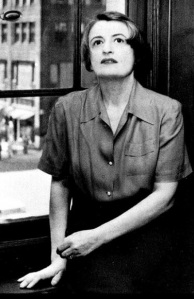
Recognized for her bestselling novels The Fountainhead and Atlas Shrugged, Ayn Rand is one of the most well known philosophers of the 21st century.
Life
Ayn Rand was born Alissa Zinovievna Rosenbaum on February 2, 1905 in St. Petersburg, Russia. She was born three weeks after the short but well known, 1905 Revolution where over twelve thousand of Czar Nicholas II's cavalrymen opened fire on thirty thousand individuals including students, labor organizers, factory workers and their families. They were marching that day for several requests including better working conditions. This horrific episode caused several days of rioting through the city and set the scene for the Bolshevik Revolution which took place in 1917. Ayn's father was a pharmaceutical chemist and her mother had trained as a dentist but stopped practicing after her marriage. Ayn, a Russian Jew and the eldest of three daughters, grew up in a time where Russia experienced massive labor strikes, anti-czarist rebellions, anti-Jewish violence and World War I. Although St. Petersburg was relatively safe from anti-Semitic violence, it was rampant in other areas of Russia. However, during this time her family prospered and her mother, a socially ambitious woman, made sure that her daughters were educated in the arts and languages.
Rand, much to her mother's dismay, was not antisocial, however did not have a lot of friends. Her lack of friends was due to several character flaws. One was she saw people as having major imperfections which she could not tolerate, and another was her intelligence. She was often viewed as different and became very set in what she wanted to do in her life. At age eight, she read books such as The Mysterious Valley by Maurice Champagne and Rudyard Kipling's stories. By the age of ten she wrote several short novels and also journaled during various periods of her life. In a biography written about Ayn Rand, Anne Heller (2009) recalls an assignment in school where the girls were to write a few paragraphs about childhood being a joyous time. Rand did not agree with that premise and quoted from such philosophers as Descartes and Pascal. During her school years, she became lonely and would make up stories of people similar to her, which led to her later writings having idealized characters that found reality needed correcting. When Rand was twelve she began to examine her own ideas and beliefs as thoughtfully as she did others and later became a self-taught metaphysician.
Rand was educated in Russia, studying history, politics, philosophy as well as literature. After graduating from the university, she moved to the United States, vowing never to return to her native communistic state. A recent biography states that a "number of events took place that solidified her 'sense of life'" (Heller, 2009) which influenced her in later years. One event was a university course in Ancient World Views which studied philosophers such as Plato, Aristotle and Kant. Another was the introduction to American silent films which had been censored by the Soviet government but led to a fascination that would later be part of her life.
She came to America to live with her aunt and uncle in Chicago in 1926 with four movie scenarios, her typewriter in its case and numerous other ideas. She eventually made her way to Hollywood where she worked at Warner Bros. as a screenwriter. During her employment, she was able to take sabbaticals to allow time to write. Her writings hint of her life experiences. For example in We the Living, Rand's first autobiographical novel, the heroine's mother was similar to her own mother.
Philosophy
Rand's philosophy, based on Aristotle, was objectivism. She believed "the concept of man as a heroic being, with his own happiness as the moral purpose of his life, with productive achievement as his noblest activity, and reason as his only absolute" (Rand, appendix to Atlas Shrugged).
"Rand was a champion and advocate of reason, self-interest individual rights, and political and economic freedom" (Branden, 1984)
Fundamentals of Ayn Rand philosophy (Objectivism):
1. The View of Reality (Metaphysics) - Things are what they are and independent of anyone's knowledge or wishes. (ARI)
2. The View of Knowledge (Epistemology) - Reason is man's only means of knowledge. (Peikoff, 1997)
3. The View of Human Nature - Individuals have free will and thus control their own lives (ARI).
4. The View of Ethics - Rational self interest (one's interest is by reason that takes into account consequences of actions). Rand believed a moral person is one who acts and is committed to acting in his best self-interest and this helps one survive, flourish and achieve happiness (IEP).
5. The View of Art - "man's profound need of art lies in the fact that his cognitive faculty is conceptual" (TAS).
6. The View of Politics - Capitalism is the only moral social system and the only purpose of the government is to protect an individual's right to life, liberty, property and pursuit of happiness (ARI). |
Works of Ayn Rand
We the Living 1936
The Fountainhead 1943
Atlas Shrugged 1957
The Objectivist Newsletter (a series of periodicals published) 1962 to 1965
The Objectivist (a larger periodical published) 1966 to 1971
The Ayn Rand Letter 1971-1976
The Virtue of Selfishness 1964
Capitalism: The Unknown Ideal 1966
Introduction of Objectivist Epistemology 1969
The Romantic Manifesto 1969
For more Books by Ayn Rand
http://www.noblesoul.com/orc/books/rand/index.html
Connection with Nursing Science
Rand once wrote "Reality exists as an objective absolute - facts are facts, independent of man's feelings, wishes, hopes or fears" (Rand, 1962). Objectivism has a connection to nursing science because objectivity is important in empiricism. It requires that "all scientific reasoning must be as free of bias as is humanly possible" (Weiss, 1995). Rand felt that logic was the "art of non-contradictory identification" (TAS) and that there could be no contradictions in reality, that two ideas must contradict each other for they could not both be true. In the science of nursing, the deductive reasoning facilitates objectivity through findings of other research and conceptualizations, but will never be completely void of biases (Weiss, 1995). Being objective is one of the main ideas in scientific reasoning and the nursing process. |
References
Branden, N (1984) The Benefits and Hazards of the Philosophy of Ayn Rand :A personal statement. (Online) Retrieved 2/20/2010. http://www.nathanielbranden.com/catalog/articles_essays/benefits_and_hazards.html
Heller, A (2009) Ayn Rand and the World She Made, Double Day, NY
Peikoff, L. (1997) The philosophy of objectivism: a brief summary. (Online) Retrieved January 31, 2010. http://www.aynrand.org/site/PageServer?pagename=objectivism_pobs
Rand, A. (1962) Introducing Objectivism, The Objectivist Newsletter 1(8) pg35.
The Atlas Society (TAS) About objectivism. (Online) Retrieved 2/7/2010 http://www.atlassociety.org/cth-31-1351-About_Objectivism.aspx
The Ayn Rand Institute (ARI) (Online) Retrieved January 30, 2010 http://www.aynrand.org/site/PageServer?pagename=objectivism_intro
The Internet Encyclopedia of Philosophy (IEP) (Online) Retrieved February 20, 2010. http://www.utm.edu/research/iep/r/rand.htm
Weiss, S. (1995). Contemporary Empiricism. In Omery, A., Kasper, C. and Page, G. (Eds.) In Search of Nursing Science. (pp.3-12) Thousand Oaks, CA: Sage |